
Help search engines find and understand your website
Publishing a website does not mean that it will automatically appear in search results. Before Google and other search engines can display its content, they first need to find it, analyse it and add it to their indexes.
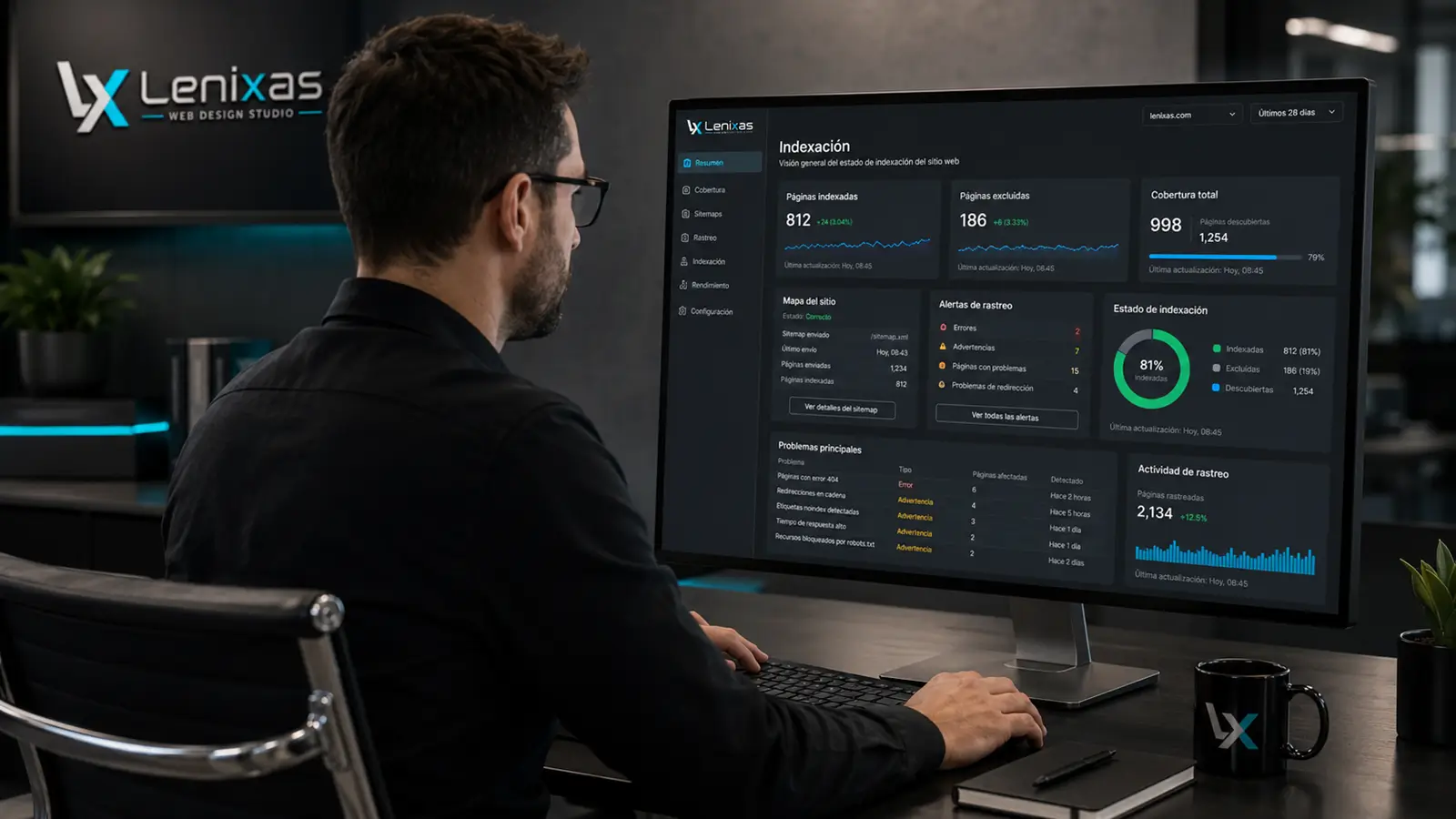
Website indexing is an essential part of online visibility. A page that has not been indexed may work correctly and remain available to users who know its address, but it will not appear in searches related to its services.
At Lenixas Web Design Studio we review the technical structure of your website, identify possible indexing issues and configure the elements required to make its content easier for search engines to access.
What is website indexing?
Indexing is the process through which search engines discover, analyse and store information about a website.
Their robots, also known as crawlers, explore the Internet by following links and visiting different addresses. When they find a page, they analyse elements such as:
- titles and headings;
- text and images;
- internal links;
- navigation structure;
- technical data;
- multimedia content;
- the date and frequency of updates;
- the relationship with other pages on the site.
After analysing it, the search engine may add it to its index and decide which queries it could be relevant for.
Indexing does not guarantee a particular ranking. It is the preliminary step that allows a page to participate in search results.
Why is indexing important?
If a page is not indexed, users are unlikely to find it through organic search.
Correctly configured indexing helps to:
- increase the possibility of appearing in search engines;
- make new pages easier to discover;
- communicate important updates and changes;
- detect technical errors;
- organise the site structure more effectively;
- prevent unnecessary content from being indexed;
- create a suitable foundation for SEO positioning.
The aim is not to index absolutely everything. Some private, duplicated, technical or low-value pages may need to remain outside the search results.

Crawling and indexing: two different processes
Although they are often used as similar concepts, crawling and indexing are not exactly the same.
Crawling occurs when search engine robots visit and analyse an address. Indexing happens when the analysed content is added to the search engine’s index.
A page can be crawled without being indexed. This may happen for different reasons:
- duplicate content;
- limited or low-quality information;
- technical instructions that block indexing;
- server errors;
- problems with the URL;
- pages that are too similar;
- insufficient internal links;
- incorrectly configured canonical tags.
That is why it is important to analyse each case rather than simply requesting indexing.
Google Search Console
Google Search Console is a tool that allows you to monitor how Google discovers and interprets a website.
From this platform, it is possible to:
- check whether a URL is indexed;
- request a page review;
- submit the sitemap;
- detect crawling errors;
- review excluded pages;
- check mobile usability issues;
- analyse queries and clicks;
- monitor changes related to visibility.
The available information helps identify issues, but it must be interpreted correctly. Not every warning indicates a serious problem, and not every excluded page needs to be indexed.
The XML sitemap
An XML sitemap is a file containing the main addresses of a website that helps search engines discover its content.
It may include:
- service pages;
- blog articles;
- categories;
- products;
- information pages;
- other relevant content.
The sitemap does not force Google to index every address, but it makes it easier to discover new or updated pages.
It is important that the file is generated correctly, contains only valid addresses and is updated whenever the site structure changes.
Internal links and navigation structure
Internal links connect the different pages of a website and help both users and search engines understand how it is organised.
A well-prepared structure makes it possible to indicate:
- which pages are the most important;
- which content is related;
- how services are organised;
- which pages have greater importance;
- how users can navigate through the site.
Isolated pages with no links from other sections may be more difficult to discover and interpret.
That is why we review the navigation and the relationship between content to make crawling more organised.
Unique and relevant content
Indexing also depends on content quality. Search engines try to avoid displaying repeated, empty or unhelpful pages.
Every important page should have:
- a clear purpose;
- a specific title;
- original content;
- a clear structure;
- useful information for visitors;
- a direct connection with the service or subject covered.
Creating several almost identical pages with only a few words changed may cause some of them not to be indexed or to compete with one another.
Managing unnecessary pages
Not every address on a website should appear in Google. In certain projects, it is advisable to exclude pages such as:
- private areas;
- login panels;
- internal search results;
- duplicate pages;
- filters and parameters;
- temporary content;
- test pages;
- sections with no value for search engines.
Indexing should be managed strategically. Keeping unnecessary addresses out of Google helps focus crawling on the content that truly matters.
Errors that can prevent indexing
There are different technical issues that can limit search engine access to a page.
The most common include:
noindextags;- blocks in the robots.txt file;
- 404 errors;
- incorrect redirects;
- password-protected pages;
- server problems;
- content generated only through scripts;
- broken links;
- incorrectly configured canonical tags;
- excessive loading times.
During the review, we check these elements and determine which ones require correction.
Indexing new and updated content
When a page is published or important content is modified, the search engine needs to visit it again to detect the changes.
To make this process easier, the following can be used:
- updated sitemaps;
- internal links;
- regular content publishing;
- review requests;
- a clear technical structure;
- stable URLs;
- accessible navigation.
The time needed for a page to be crawled and indexed may vary. Requesting a review does not mean that the content will appear immediately or achieve a particular ranking.
What can our indexing service include?
The scope depends on the size and condition of the website, but it may include:
- Google Search Console configuration;
- review of the indexing status;
- creation or verification of the XML sitemap;
- detection of blocked pages;
- review of the robots.txt file;
- analysis of
noindextags; - verification of internal links;
- detection of 404 errors;
- review of redirects;
- configuration of canonical tags;
- submission of important pages;
- monitoring of technical issues.
Our aim is to make it easier for search engines to find relevant pages and correctly understand the structure of the site.
An essential foundation for improving your visibility
Indexing is the first step that allows a page to appear in search results. However, it must be supported by high-quality content, a solid technical structure and a consistent SEO strategy.
At Lenixas Web Design Studio we review the elements that may be limiting your website’s visibility and prepare a clearer structure for both search engines and users.
Check whether your website is correctly indexed
We will analyse the status of your website, identify possible blocks and recommend the improvements needed to make its most important content easier to index.