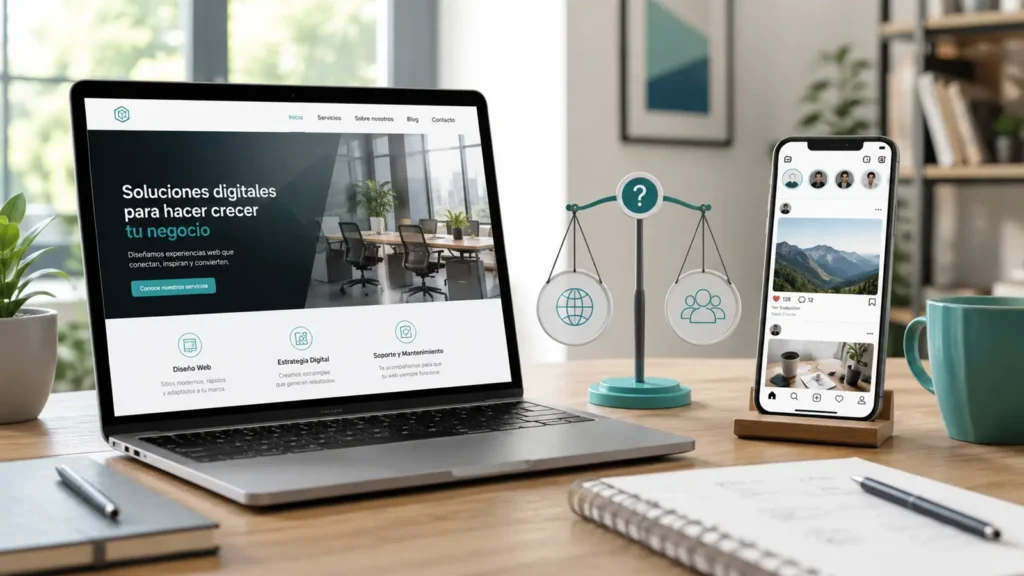

What type of website does your business need?
Deciding that a company needs a website is only the first step. Then an even more important question arises:
What type of website does the business really need?
Not every company requires the same structure, number of pages or functions.
A professional offering a single service can start with a simple website. A company with several areas of activity needs to present each service separately. A shop must allow users to browse products, make payments and manage orders. A tourism business may require availability, bookings and several languages.
Choosing a solution that is too small can limit the company’s growth. However, commissioning functions from the outset that will not be used can also increase the budget unnecessarily and complicate management.
The right website should meet the business’s current needs while also allowing it to be expanded in the future.
Before choosing, it is also advisable to know what a professional website should include to build trust, work correctly and make contact with clients easier.
Below, we analyse the main types of websites and explain which companies each solution may suit.
1. First define what the website should achieve
Before deciding on the design or number of sections, it is necessary to establish the website’s main objective.
A website may be created to:
- present a company;
- explain its services;
- generate quotation requests;
- receive calls;
- generate bookings;
- sell products;
- present projects;
- capture leads;
- publish content;
- display information in several languages;
- serve clients in different locations;
- provide access to documentation;
- build a community;
- offer an online service.
A company may have several objectives, but it is advisable to identify which one is most important.
For example, a website for a renovation company may focus on showing projects and generating quotation requests.
A clinic may need to present treatments, build trust and make appointment booking easier.
A shop needs to organise products and allow the entire purchase process to be completed.
A self-employed professional can use the website to explain their experience, present a specific service and receive enquiries.
It is also important to understand the ideal client:
- what information are they looking for?;
- which device do they use to visit?;
- what questions do they have?;
- what do they need to check before making contact?;
- do they prefer to call, write or book online?;
- which language do they use to view the information?;
- are they looking for a local service or one available in different areas?
The website structure should make the journey from the first visit to the final action easy.
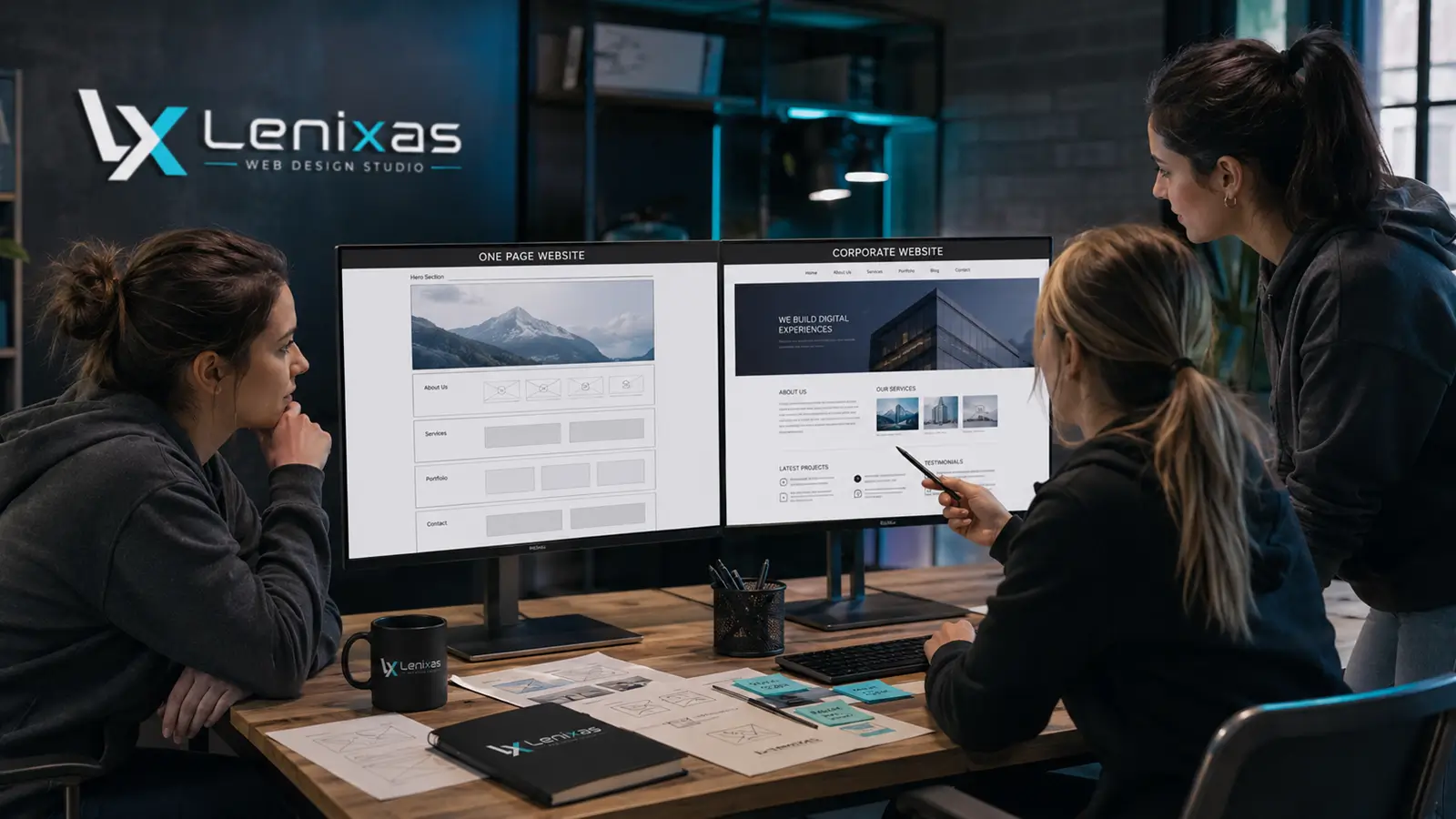
2. A One Page website for a simple offer
A One Page website is a site where the main information is organised on a single page.
Visitors can move through different sections, such as:
- presentation;
- services;
- benefits;
- information about the company;
- projects;
- reviews;
- frequently asked questions;
- contact.
The menu can direct users automatically to each section without opening a different URL.
This type of website may be suitable for:
- a self-employed professional;
- a company that has just started;
- a single service;
- a specific campaign;
- an event;
- a small local business;
- a temporary presentation;
- a project with a very simple offer.
Its advantages include:
- an easy-to-understand structure;
- quick navigation;
- less initial content;
- a clear presentation of a specific offer;
- the possibility of creating a professional presence without an extensive website;
- simpler maintenance.
However, a One Page website also has limitations.
When a company offers numerous services, operates in different locations or wants to rank for different Google searches, a single page may be insufficient.
It can also become too long if all information is included within the same structure.
A One Page website should be used when it genuinely meets the project’s needs, not merely because it is the smallest option.
3. A corporate website to present the whole company
A corporate website consists of several sections or subpages.
It may include:
- Home;
- About us;
- Services;
- individual pages for each service;
- Projects;
- Frequently asked questions;
- Blog;
- Contact.
This solution is suitable for companies that need to present their activity more comprehensively.
It may be recommended for:
- small and medium-sized companies;
- professional firms;
- agencies;
- clinics;
- construction companies;
- tourism businesses;
- sports centres;
- beauty centres;
- transport companies;
- academies;
- companies with different services.
The main advantage is that it allows information to be organised more effectively.
Each service can have its own page, with:
- a detailed explanation;
- benefits;
- working process;
- photographs;
- frequently asked questions;
- related projects;
- contact button;
- a specific form.
This helps clients find exactly what they need.
It also allows a structure better suited to SEO, as each page can focus on a specific offer.
For example, a web design company can separate:
- corporate website creation;
- online shops;
- responsive design;
- maintenance;
- optimisation;
- logo creation.
A corporate website can also be expanded over time. If the company adds a new service, it can add a new section without completely changing the rest of the site.
You can view our web design services and see how different solutions can be organised within the same business website.
4. A service website to generate client enquiries
Many companies do not sell products directly online. Their main objective is to generate contacts from people interested in their services.
In this case, the website should be prepared to turn visits into:
- calls;
- messages;
- quotation requests;
- bookings;
- meetings;
- enquiries;
- visits to the premises.
A service website may be suitable for:
- lawyers;
- advisers;
- renovation companies;
- electricians;
- photographers;
- designers;
- trainers;
- clinics;
- cleaning companies;
- workshops;
- estate agencies;
- tourism companies;
- independent specialists.
Each service should be explained clearly.
Visitors need to know:
- what it includes;
- who it is intended for;
- which problem it solves;
- how it works;
- how much time it requires;
- which area it is available in;
- how they can request it;
- what makes the company different.
The website should also include visible calls to action.
For example:
- Request your quotation;
- Book a consultation;
- Contact us;
- Request more information;
- Check availability;
- Call us;
- Send a message.
A service website should not be limited to presenting general information. It should help users make a decision and make the next step easy.
Completed projects, reviews and an explanation of the process can also increase trust.
You can review our latest website projects to discover different ways of presenting professional services.
5. An online shop for selling products
An online shop allows products to be presented and the purchase process to be completed through the website.
This type of project may include:
- categories;
- product pages;
- photographs;
- variants;
- prices;
- promotions;
- shopping basket;
- payments;
- shipping costs;
- taxes;
- client accounts;
- order management;
- automatic emails;
- returns;
- stock control.
An online shop may be suitable for:
- product brands;
- local retailers;
- manufacturers;
- distributors;
- craft businesses;
- specialist shops;
- companies that want to sell in different areas;
- businesses that currently sell only through social media.
Before creating it, it is necessary to analyse how the business actually operates.
It is advisable to define:
- how many products will be published;
- whether there are variants;
- how stock will be managed;
- which payment methods will be used;
- where orders will be shipped;
- how much delivery will cost;
- which taxes will apply;
- who will prepare the photographs and descriptions;
- who will update the products;
- how returns will be managed.
An online shop does not end when the website is published. It requires ongoing management.
The company must add products, update prices, process orders and respond to clients.
It also needs purchase terms, shipping and returns information, privacy information and other legal elements related to its activity.
A simple shop can start with a limited number of products and be expanded later.
The important thing is to plan the structure correctly from the beginning.
6. A booking website for businesses that work with appointments or availability
Some companies need more than a contact form.
When clients need to select a date, time, activity or service, integrating a booking system may be useful.
This type of website may be suitable for:
- beauty centres;
- clinics;
- trainers;
- academies;
- restaurants;
- accommodation providers;
- rental companies;
- excursions;
- sports activities;
- tourism services;
- professionals who work by appointment;
- vehicle or boat hire.
Depending on the project, the system may allow users to:
- select a service;
- choose a date;
- check availability;
- choose a time;
- state the number of people;
- pay online;
- receive confirmations;
- change or cancel a booking;
- receive reminders;
- manage calendars;
- limit places;
- apply special conditions.
Before choosing a tool, it is necessary to understand the business’s daily operation.
For example:
- do all services take the same amount of time?;
- does each employee have their own calendar?;
- are there different opening hours?;
- are there unavailable days?;
- is full payment or a deposit required?;
- can a booking be cancelled?;
- does availability change depending on the season?;
- are individual or group services sold?
A system that is too simple may not meet these needs. One that is too complex may make management difficult.
In some cases, a request form may be sufficient. In others, real-time availability will need to be displayed.
The solution should be adapted to the company’s actual process.
7. A multilingual website for working with international clients
A company serving people from different countries may need several language versions.
This is especially important for:
- tourism companies;
- accommodation providers;
- restaurants;
- estate agencies;
- clinics;
- companies located in international areas;
- businesses selling in several countries;
- transport companies;
- schools;
- professionals serving foreign residents.
A multilingual website is not simply a matter of adding an automatic translator.
Each version should be organised correctly and allow users to change language easily.
It is also necessary to review:
- headings;
- buttons;
- forms;
- automatic emails;
- menus;
- prices;
- terms;
- legal information;
- images containing text;
- URLs;
- blog content.
Translations should be understandable and appropriate for the audience.
A word-for-word translation may contain unnatural expressions or fail to explain the service correctly.
It is also advisable to decide whether every language will have exactly the same content.
A company may offer certain services only in some areas or languages. In that case, the structure should reflect those differences.
A multilingual website requires more content and maintenance, but it can make contact easier for clients who are not comfortable using another language.
8. A blog to increase visibility and answer questions
A blog can form part of a corporate website, an online shop or a service website.
Its purpose should not be to publish content merely to make the website appear active.
Articles should answer questions related to potential clients’ decisions.
A blog can help to:
- explain services;
- answer questions;
- compare options;
- present solutions;
- demonstrate experience;
- target different searches;
- direct users to service pages;
- increase trust;
- support promotion on social media.
For example, a web design company can publish articles about:
- types of websites;
- prices;
- necessary elements;
- choosing a provider;
- redesign;
- differences between a website and social media.
A clinic can publish content about treatments, preparation and aftercare.
A tourism company can explain routes, seasons, terms and recommendations.
Articles should be related to the commercial activity.
Content that attracts many visits but is unrelated to the services may not generate clients.
It is also important to include internal links.
In our article website or social media we explain how to use both channels in a coordinated way to attract and convert clients.
9. A landing page for a specific campaign
A landing page is a page created for a specific objective.
It can be used for:
- an advertising campaign;
- the launch of a service;
- a promotion;
- a limited offer;
- registration for an event;
- downloading a document;
- lead generation;
- a social media campaign;
- booking a consultation.
Unlike a complete corporate website, a landing page focuses attention on a single action.
It usually includes:
- a main message;
- an explanation of the offer;
- benefits;
- trust-building elements;
- answers to objections;
- form;
- a call to action.
Navigation may be more limited to avoid distractions.
For example, a company can direct an advertisement for a specific service to a landing page dedicated exclusively to that offer.
This allows the message to be adapted to people arriving from the campaign.
A landing page does not always replace the company’s main website.
In many cases, it works as an additional section connected to the corporate website.
It can be particularly useful when a company offers numerous services but wants to promote one of them independently.
10. A customised solution for more complex projects
Some businesses need functions that do not fit completely within a standard corporate website, shop or booking system.
This may involve:
- a classified listings platform;
- a directory;
- a marketplace;
- a private area;
- a course platform;
- a subscription system;
- user accounts;
- content publication by clients;
- custom dashboards;
- advanced search tools;
- comparison systems;
- integration with external software;
- document management;
- calculation tools.
In these cases, before starting the design it is necessary to analyse:
- the types of users;
- the functions of each account;
- the data that will be stored;
- the registration process;
- payments;
- notifications;
- administration;
- security;
- integrations;
- future expansions.
A customised solution requires more planning, testing and development.
It may also be advisable to divide the project into stages.
The first version can include the essential functions. Later, based on actual use and client feedback, new tools can be added.
This approach helps avoid creating expensive functions that will not be used afterwards.
Before commissioning a more complex project, it is particularly important to know how to choose a web design company and which questions to ask about ownership, access, support and expansions.
How do you know which option your company needs?
To make a decision, answer these questions:
- How many services do you offer?
- Does each service need a detailed explanation?
- Do you want to sell products?
- Do you need bookings?
- Do you work with clients in different languages?
- Do you want to appear on Google for different services?
- Do you need to publish content regularly?
- Do clients need to create an account?
- Do you need to receive payments?
- Do you want to show projects?
- Do you operate in several locations?
- Will the website need to be expanded in the future?
- Who will manage the content?
- What budget do you have available?
- What is the website’s main objective?
The answers make it possible to define an initial structure.
For example:
A self-employed professional with a single service
They can start with a One Page website or a small professional website.
A company with several services
They will probably need a corporate website with a separate section for each offer.
A company that sells products
They will need an online shop.
A business that works with appointments
It may require a booking system or at least a form adapted to its process.
A tourism company
It may need services, bookings, several languages, maps, frequently asked questions and cancellation terms.
A company that wants to invest in advertising
It can combine a corporate website with landing pages for specific campaigns.
A digital project or marketplace
It may require custom development and planning divided into stages.
Is it better to start with a small website and expand it later?
In many cases, yes.
A new company can start with a simple structure and add new functions when it genuinely needs them.
For example, it can start with:
- presentation;
- services;
- information about the company;
- form;
- contact.
Later, it can add:
- blog;
- projects;
- languages;
- bookings;
- shop;
- payments;
- private area.
However, the first version should be planned properly.
A structure created without considering future expansion can make growth difficult.
For this reason, even a simple website should be built on a foundation that allows new pages and functions to be added.
It is also important not to remove essential elements merely to reduce the price.
A small website still needs:
- mobile adaptation;
- professional design;
- security;
- speed;
- clear information;
- a working form;
- client access;
- an understandable structure;
- basic preparation for Google.
What happens if you already have a website?
If the company already has a website, it is advisable to check whether it still meets its needs.
The website may have been suitable when it was created, but the business may have changed.
For example:
- you now offer more services;
- you operate in new areas;
- you need other languages;
- you want to receive payments;
- you have changed the company’s image;
- you need bookings;
- you want to create a shop;
- the website does not work correctly on mobile phones;
- it does not generate enquiries;
- it does not represent the company’s current quality.
In these cases, it may be necessary to expand the website or carry out a redesign.
In our article about the signs that a website needs a redesign we explain how to recognise the main problems of an old or ineffective website.
How much does each type of website cost?
The price depends on the structure, content and functions.
A One Page website usually requires less work than a corporate website with numerous sections.
An online shop requires products, payments, orders and terms of sale to be configured.
A booking website may require calendars, availability and automatic emails.
A customised platform requires more advanced analysis, development and testing.
The quotation may depend on:
- number of pages;
- number of services;
- design;
- texts;
- photographs;
- languages;
- forms;
- shop;
- bookings;
- payments;
- integrations;
- content migration;
- maintenance;
- support.
It is not advisable to compare only the final price.
Two proposals with similar names may include very different elements.
In our next article, we explain how much a professional website costs and which factors genuinely influence its price.
You can also view our website prices and review what each solution includes.
Common mistakes when choosing the type of website
One of the most common mistakes is commissioning a website because it appears inexpensive without checking whether it can present the entire offer correctly.
Other mistakes include:
- choosing a One Page website for too many services;
- creating a shop without planning product management;
- installing a booking system that does not suit the way the business operates;
- adding too many functions from the beginning;
- not preparing the mobile version;
- forgetting about languages;
- copying a competitor’s structure;
- not defining who will create the content;
- not considering future expansion;
- choosing the design before defining the objectives;
- not checking who will own the domain and website.
The right solution does not have to be the largest.
It should be complete enough to achieve the objectives and simple enough for the company to manage.
The right website should grow together with your business
A professional website should represent the company’s current situation and be prepared for its next steps.
It can start with a simple structure, but it should allow the addition of:
- new services;
- projects;
- languages;
- articles;
- bookings;
- products;
- forms;
- locations;
- integrations.
At Lenixas, we analyse every project before recommending a solution.
We study the company’s activity, clients, services and the objectives the website must achieve.
You can discover our web design services.
View our website prices and compare the different options.
You can also review our latest completed projects.
The best solution is not necessarily the largest, but the one that correctly meets your company’s current needs and allows future expansion. Discover Lenixas and our web design solutions to find out how we can help you choose a suitable structure for your business.
Not sure what type of website your business needs?
Tell us what your company does, which services it offers and which objectives you want to achieve.
We will analyse your needs and propose a structure tailored to your business without adding unnecessary functions.