
How much does a professional website cost?
One of the first questions any company asks before starting a digital project is:
How much does it cost to create a professional website?
The answer cannot be reduced to a single figure.
The price depends on the type of website, the number of pages, the design, the content, the languages, the functions and the work required to prepare the entire project correctly.
A simple website for a self-employed professional does not require the same level of development as a corporate website with numerous services, an online shop or a platform where users can register and publish content.
There are also significant differences between proposals from different providers.
Some quotations include the domain, hosting, mobile version, forms, basic optimisation, security and support. Others show a low initial price but later add numerous extra costs.
For this reason, before comparing figures, it is necessary to check what each offer actually contains.
In Spain, simple projects can be found from several hundred euros, while a more complete corporate website may cost several thousand. Advanced online shops and custom-developed platforms can cost considerably more. Pricing guides published in 2026 show very broad ranges precisely because completely different projects are offered under the term “professional website”.
Before requesting a quotation, it is advisable to analyse what type of website your business needs.
Below, we explain how much each type of website may cost, which elements affect the price and what you should check before hiring.
1. There is no single price for every website
Asking how much a website costs is similar to asking how much it costs to renovate commercial premises.
The price depends on what needs to be built.
A website may contain only:
- a brief presentation;
- one service;
- a few photographs;
- contact details;
- a form.
Another may require:
- numerous service pages;
- several languages;
- blog;
- projects;
- custom forms;
- payments;
- bookings;
- user accounts;
- search tools;
- integration with external software;
- an online shop;
- automations.
Although both are called websites, the amount of work involved is completely different.
The way the project is prepared also affects the price.
Using a template with almost no modifications does not cost the same as creating a structure adapted to the company, organising its content and reviewing every section for computers, tablets and mobile phones.
For this reason, a professional quotation should clearly explain:
- what type of website will be created;
- how many pages it will include;
- which functions it will have;
- who will prepare the content;
- which services will be included;
- which costs will arise after publication.
An isolated figure does not indicate whether an offer is inexpensive, expensive or suitable.
2. Guide prices for a website in Spain
The following prices are indicative and may vary depending on the provider, scope and complexity of the project.
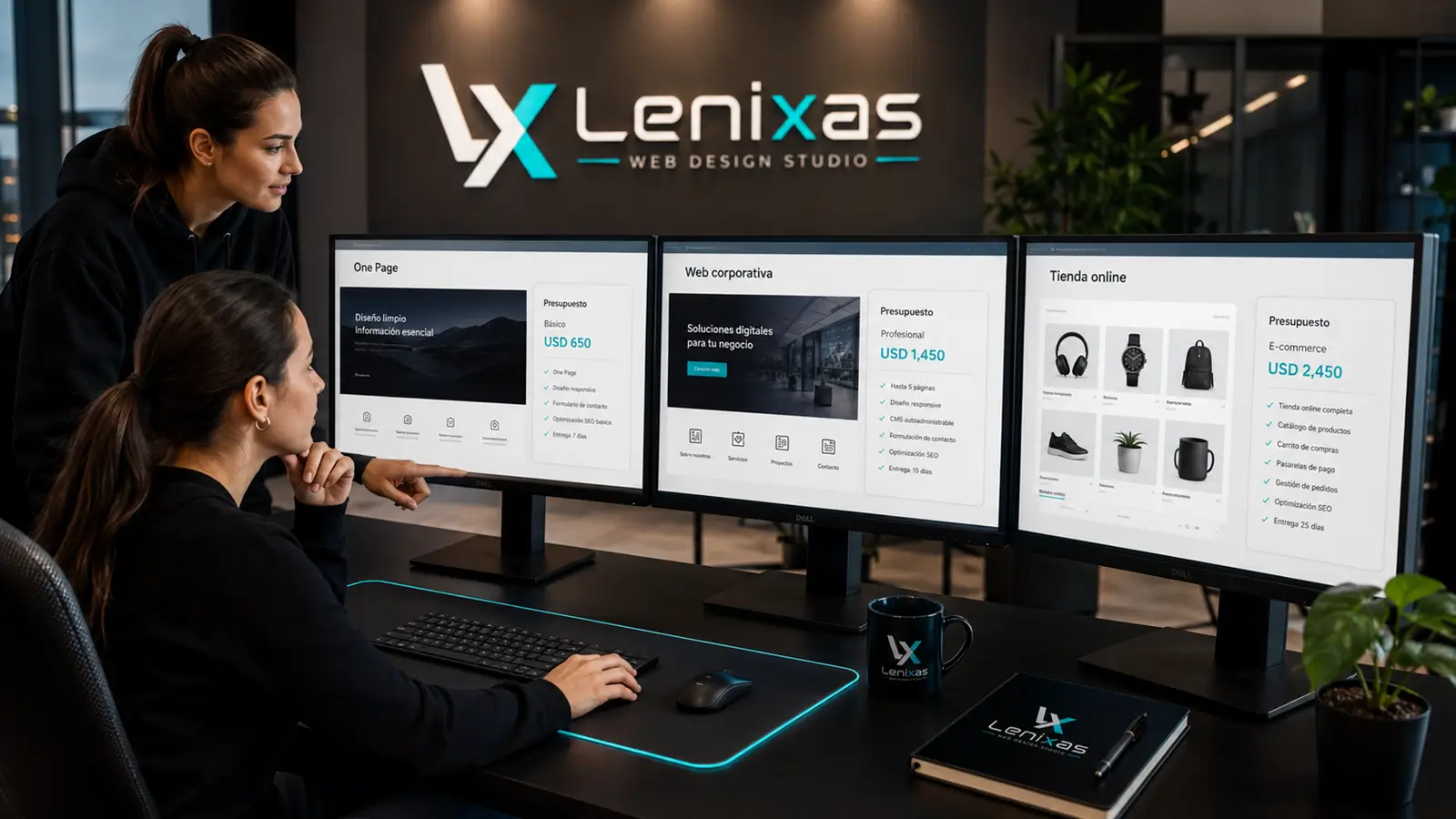
One Page website or simple landing page
Guide price: between 300 and 1,000 euros
It may include:
- a single page;
- company presentation;
- description of one service;
- several sections;
- form;
- contact details;
- mobile version;
- WhatsApp button.
It may be suitable for a self-employed professional, a new company, a campaign or a very specific service.
Small website for self-employed professionals and local businesses
Guide price: between 700 and 2,000 euros
It may include:
- homepage;
- company presentation;
- services;
- frequently asked questions;
- contact;
- form;
- responsive design;
- basic search engine configuration.
This is a common option for small companies that need to present their activity clearly and receive enquiries.
Professional corporate website
Guide price: between 1,500 and 5,000 euros
It may include:
- several service pages;
- more customised design;
- projects;
- blog;
- different forms;
- more developed texts;
- technical optimisation;
- several languages;
- integration with external tools.
The price increases when the company has a broad offer or needs a structure specifically prepared to attract clients.
Online shop
Guide price: between 2,000 and 8,000 euros or more
It may include:
- products;
- categories;
- variants;
- shopping basket;
- payments;
- orders;
- client accounts;
- shipping;
- taxes;
- automatic emails;
- purchase terms;
- stock management.
The number of products and required functions can increase the budget considerably.
Platform or custom development
Guide price: from 5,000 euros to more than 15,000 euros
It may include:
- user registrations;
- private areas;
- directories;
- marketplaces;
- advertisement publishing;
- subscriptions;
- advanced search tools;
- custom dashboards;
- integrations;
- automations.
These projects require more analysis, programming, testing and support.
The ranges above are not official rates. They are a general reference based on prices published by professionals and companies in the Spanish market. The final quotation should be calculated after understanding the business’s actual needs.
You can view our website prices to check what each Lenixas solution includes.
3. The type of website directly affects the price
One of the most important factors is the type of project.
A One Page website concentrates the information under a single URL. It may include several sections but normally requires less content and a simpler structure.
A corporate website requires different pages and broader navigation. Each service may need its own content, photographs, buttons and form.
An online shop adds a complete purchasing process.
In addition to designing the website, it is necessary to configure:
- products;
- categories;
- payment methods;
- taxes;
- shipping;
- orders;
- emails;
- client accounts;
- terms of sale.
A booking website may require calendars, schedules, availability, payments and automatic confirmations.
A custom platform may require registrations, user accounts, content publishing and tools created specifically for the project.
The more complex the operation, the more time will be needed to plan, develop and test the website.
For this reason, before asking only about the price, it is advisable to define what the website must be able to do.
It makes no sense to pay for an online shop when the company does not sell products. It is also not advisable to commission a website that is too simple when the business needs to present ten different services.
A suitable solution should include what is needed to achieve the objectives without adding functions that will never be used.
4. The number of pages and services increases the workload
A website with four sections does not require the same preparation as a website with twenty individual pages.
Each new page may require:
- structure;
- title;
- texts;
- photographs;
- buttons;
- links;
- mobile adaptation;
- search engine configuration;
- review;
- corrections.
For example, a company may offer:
- web design;
- online shops;
- maintenance;
- SEO;
- graphic design;
- logo creation.
If all services are summarised in a single block, the cost will be lower, but there will also be less space to explain them properly.
If each service has a separate page, the project will require more work, although the offer will be much clearer to the client.
The number of pages also matters when creating:
- a blog;
- a project section;
- different locations;
- several language versions;
- campaign pages;
- product categories;
- frequently asked questions.
It is not always necessary to prepare the entire structure from the first day.
A company can start with the main pages and expand the website later.
However, the initial structure should be prepared for that growth.
In our article about what a professional website should include we explain which elements are genuinely important for presenting a company and making contact easier.
5. Custom design and content preparation have a cost
Design is not simply about choosing colours.
A professional website should take into account:
- visual identity;
- logo;
- fonts;
- the arrangement of sections;
- the size of elements;
- photographs;
- buttons;
- navigation;
- mobile version;
- user experience.
A template can reduce the amount of work, especially when it is adapted correctly.
However, more advanced customisation requires analysing the company and preparing an appearance suited to its needs.
It is also important to define who will provide the content.
The quotation may change if the provider must take responsibility for:
- writing texts;
- proofreading content;
- researching keywords;
- selecting photographs;
- creating images;
- preparing icons;
- translating the website;
- organising the information;
- adding numerous products.
A company that already has good texts, professional photographs and a complete visual identity can reduce some of the work.
By contrast, when the project starts with only an idea and a logo, many more elements will need to be prepared.
Texts should not be treated as a secondary detail.
A website may have an excellent design, but it will not explain the offer correctly if it contains generic phrases or too little information.
The content should help the client understand:
- what the company offers;
- who the service is for;
- what it includes;
- how it works;
- which benefits it provides;
- how they can purchase it.
You can review our latest website projects to see how design and content can be adapted to different industries.

6. Functions can increase the budget considerably
An informational website is simpler than a website that must carry out automated processes.
Functions that may affect the price include:
- custom forms;
- booking systems;
- online payments;
- calendars;
- private areas;
- user accounts;
- subscriptions;
- shops;
- search tools;
- filters;
- advertisement publishing;
- interactive maps;
- connection to external software;
- email automation;
- document downloads;
- online courses;
- several types of users.
Not all functions have the same level of complexity.
Adding a WhatsApp button is relatively simple. Creating a platform where different companies manage hundreds of advertisements requires much more advanced planning.
It is also necessary to check whether an existing tool will be used or whether the function must be custom-developed.
A ready-made solution may reduce the cost, but it may include:
- annual payments;
- limitations;
- commissions;
- restrictions;
- dependence on an external provider.
Custom development allows greater adaptation, although it requires more time and budget.
Before adding a function, it is advisable to answer three questions:
- Does the company genuinely need it?
- How will it be used every day?
- Who will be responsible for managing it?
A function that appears attractive may be unnecessary if clients do not use it or if the company does not have time to manage it.
7. Domain, hosting and maintenance can also create costs
The creation price does not always include all expenses required to keep the website online.
Domain
This is the website address.
It is normally renewed every year. Its price depends on the extension and provider.
Before hiring, you should check:
- whether it is included;
- who will register it;
- in whose name it will be registered;
- how much renewal will cost;
- who will have access.
The domain should be registered in the name of the client or their company.
Hosting
This is the space where the website is stored.
The cost may depend on:
- capacity;
- performance;
- traffic;
- backups;
- email;
- security;
- support;
- the location of the servers.
Inexpensive hosting may be sufficient for a small website. A shop or platform with numerous users may require more resources.
Maintenance
After publishing the website, it may be necessary to carry out:
- updates;
- backups;
- security reviews;
- corrections;
- content changes;
- technical assistance;
- error recovery.
Some providers include an initial support period. Others offer monthly or annual maintenance.
Not every company needs the same service, but the quotation should clearly explain what will happen after publication.
You should also check whether there are annual licences for templates, extensions or external tools.
Before hiring, it is useful to know how to choose a web design company and which questions to ask about the domain, access credentials, maintenance and ownership.
8. Optimisation, security and legal elements are also part of the project
A professional website needs more than good design.
It should be prepared to work correctly, protect data and provide a suitable foundation for visibility.
The quotation may include:
- mobile adaptation;
- image optimisation;
- speed improvements;
- security certificate;
- form configuration;
- backups;
- spam protection;
- heading structure;
- titles and descriptions;
- internal links;
- a sitemap;
- indexing configuration;
- connection to analytics tools.
It is important to distinguish between basic preparation and an ongoing SEO service.
Configuring the structure of a new website correctly does not automatically guarantee top positions on Google.
SEO may require:
- search analysis;
- new content;
- articles;
- service pages;
- technical improvements;
- monitoring;
- ongoing work.
Legal elements must also be taken into account.
Depending on the project, it may be necessary to prepare:
- legal notice;
- privacy policy;
- cookie policy;
- consent wording in forms;
- contract terms;
- terms of sale;
- shipping and returns information.
A simple corporate website and an online shop do not require exactly the same documents.
For this reason, it is advisable to ask which legal texts are included and who will be responsible for preparing or reviewing them.
A very cheap offer may appear attractive but leave out important elements that will later need to be commissioned separately.

9. Check taxes and possible additional costs
Before accepting a quotation, check whether the stated price includes the applicable taxes.
Tax rules may vary depending on the country where the provider is located, the client’s location, the type of service and whether the buyer is a company or an individual.
For this reason, the quotation should clearly state:
- the price before tax;
- the tax rate applied;
- the total amount the client will have to pay;
- whether any special tax condition applies;
- whether the price includes all compulsory costs.
For example, if a website costs 1,000 euros and tax of 21% applies, the final amount would be 1,210 euros.
This percentage is only an example. The actual tax may be different depending on the country and circumstances of the transaction.
It is also advisable to check other possible costs:
- domain renewal;
- hosting;
- corporate email;
- maintenance;
- licences;
- booking tools;
- payment commissions;
- translations;
- photographs;
- text writing;
- product uploading;
- additional modifications;
- technical support;
- content migration;
- training to manage the website.
A professional quotation should clearly separate:
- the initial payment;
- stage payments;
- recurring costs;
- optional services;
- applicable taxes;
- work that is not included.
It should also explain what is considered a correction and what is considered an expansion of the project.
Changing a text or replacing a photograph is not the same as adding a booking system, a new language version or an online shop.
The clearer this information is from the beginning, the lower the risk of unexpected costs or disagreements during the project.
10. How to compare several quotations correctly
Do not compare only the final figure.
Create a list and check what each proposal includes.
You can review:
- type of website;
- number of sections;
- service pages;
- design;
- mobile version;
- texts;
- photographs;
- forms;
- languages;
- shop;
- bookings;
- payments;
- preparation for Google;
- security;
- domain;
- hosting;
- emails;
- support;
- maintenance;
- number of corrections;
- timeframe;
- ownership;
- access credentials;
- taxes.
Two offers of 900 and 1,500 euros may appear very different.
However, the first may not include texts, hosting, optimisation or support. Once all these elements are added, it may end up costing more than the second.
The opposite may also happen.
A company may offer a small, well-prepared package that fully meets the business’s needs. In that case, there is no need to pay for a larger solution.
The best proposal is not always the cheapest or the most expensive.
It is the one that:
- clearly explains what it includes;
- meets the genuine needs;
- does not add unnecessary functions;
- allows the website to be expanded;
- provides the access credentials;
- defines future costs;
- offers clear communication.
If your company already has a website, before investing in a new one it is advisable to review the signs that a website needs a redesign.
Is it possible to have a professional website for less than 500 euros?
Yes, it is possible to find offers below that amount.
However, they usually involve:
- a very simple website;
- a template with few modifications;
- a single section;
- content provided entirely by the client;
- few functions;
- limited support.
This does not automatically mean that it is a bad solution.
It may be sufficient for a professional who is just starting and needs a basic online presence.
The problem arises when something is sold as a complete website but does not include:
- proper mobile adaptation;
- forms;
- security;
- access credentials;
- basic preparation;
- support;
- domain ownership.
Before choosing a low-cost offer, check exactly what you will receive.
Is it better to pay once or take out a monthly subscription?
Both models can be suitable.
One-off payment
The client pays for the creation of the project and afterwards bears only the necessary costs, such as the domain, hosting or maintenance.
This model can provide greater clarity about the initial investment.
Monthly subscription
It may include:
- creation;
- hosting;
- support;
- maintenance;
- modifications;
- additional tools.
It may be useful for companies that prefer to avoid a high initial payment.
However, it is necessary to check:
- how much will be paid in total;
- for how long;
- what happens upon cancellation;
- whether the website will continue to work;
- who will be the owner;
- whether the files and access credentials will be provided.
A small fee may appear attractive but become a high cost after several years.
How much does it cost to maintain a website each year?
It depends on the type of project.
Costs may include:
- domain;
- hosting;
- licences;
- backups;
- security;
- updates;
- assistance;
- external tools.
A small website may have relatively low annual expenses.
A shop, platform or booking system may require more advanced services and additional licences.
The initial quotation should explain which payments will arise after publication.
You can view our frequently asked questions to learn more about website development and management.
How long does it take to create a professional website?
The timeframe depends on:
- size;
- materials;
- content;
- functions;
- languages;
- corrections;
- speed of communication.
A simple website can be prepared in less time than an extensive corporate website.
A shop or platform may require several stages of development and testing.
One of the most common causes of delay is missing materials.
When the client has not yet prepared texts, photographs, prices or information about the services, the project may come to a halt.
Before starting, it is advisable to define:
- what each party must provide;
- by which date;
- how corrections will be submitted;
- how many revisions there will be;
- when the website will be published.
You can learn more about the way we work in About us.
Does a more expensive website attract more clients?
Not necessarily.
A higher quotation may include more design, functions and content, but the website must be adapted to the business.
A simple website can achieve good results if it:
- presents the service clearly;
- answers questions;
- builds trust;
- works well on mobile devices;
- makes contact easy;
- receives suitable traffic.
An expensive website may fail to generate enquiries when:
- the message is confusing;
- the offer is not explained well;
- the buttons are not visible;
- navigation is complicated;
- it receives no promotion;
- it targets the wrong audience.
The price should correspond to the objective, not merely the size.
It is also important to combine the website with other channels.
In our article website or social media we explain how to use both channels to increase visibility and generate enquiries.
A website should be considered an investment
A professional website should not be viewed only as a technical expense.
It can help the company to:
- present its services;
- convey trust;
- show projects;
- answer questions;
- appear in searches;
- receive enquiries;
- sell products;
- generate bookings;
- support campaigns;
- improve its image.
The investment should be adapted to the size, situation and objectives of each business.
A new company can start with a simple structure. An established company may need a broader website, several languages or specific tools.
The important thing is to know what is being commissioned.
At Lenixas, we analyse every project before recommending a solution.
Not every company needs the same number of pages or the same functions.
You can discover our web design services.
View our website prices and check which elements each option includes.
You can also review our latest completed projects.
The price of a website should be related to its objectives, structure and the work the company genuinely needs. Visit Lenixas, professional web design for companies to learn more about our solutions and request a proposal tailored to your project.
Would you like to know how much your company’s website would cost?
Tell us what your business does, how many services it offers and which functions you need.
We will analyse your project and prepare a clear proposal tailored to your objectives without adding unnecessary functions.